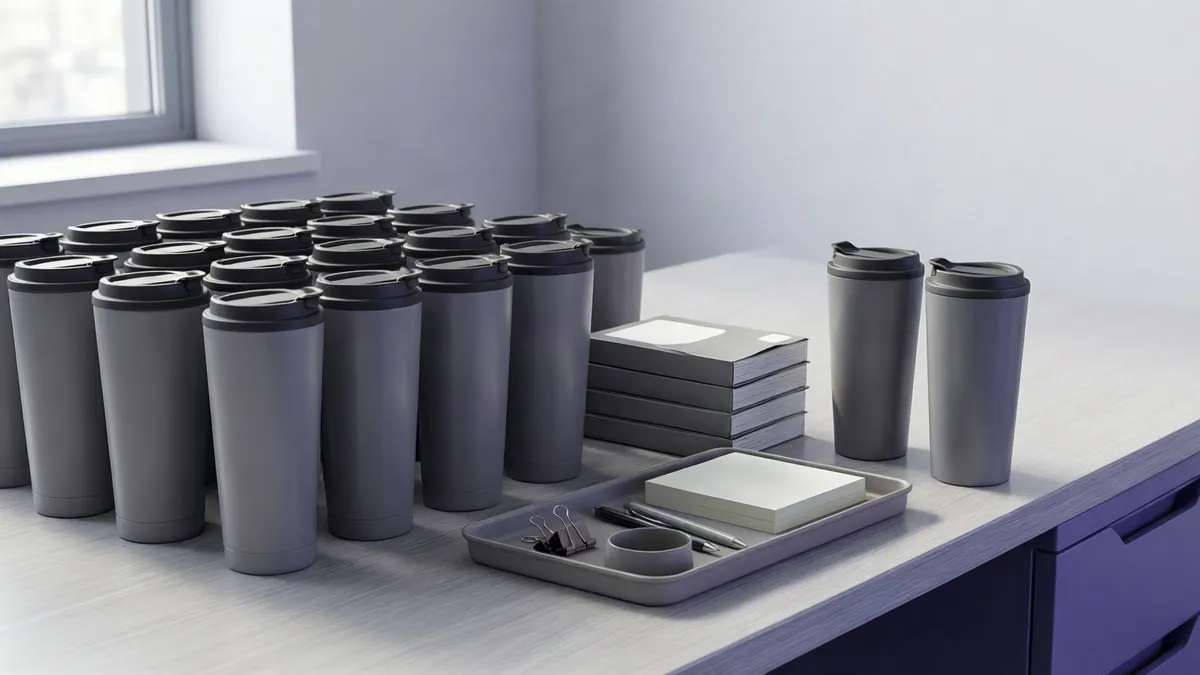
Short answer: Pick one item for all twenty, at $5 to $12 a head, and order 22 so you never count heads twice. Twenty units at $8 is $160 plus shipping; twenty at $25 is $500. That spread is why the unit price, not the item, is the real decision. Personalize nothing, buy one spare per ten people, and treat food and scent as opt-in.
These are buying guides, not reviews: we have not used every item here. Specs come from the manufacturer or the listing, and prices move constantly. Whatever Amazon shows when you click is the authoritative figure.
This article contains affiliate links. If you buy through one, we earn a small commission at no extra cost to you. We only recommend what we would suggest to a friend.
The Federal Trade Commission's endorsement guides, 16 CFR Part 255, require a disclosure like that one to be difficult to miss, so it sits above every link here. Our full affiliate disclosure has the rest.
What we measured: We read the 11 ranking pages for this search in full; one more would not load. We compared what each recommends, the prices quoted, and whether anyone does headcount math. Of the guides we analyzed, the 204 price mentions run roughly $5 to $100 with a median around $22, and 7 of the 11 cover drinkware. That median is a single-person price, which is exactly the trap at twenty units. Prices came from the guides rather than live listings, on one day, so treat them as soft.
Twenty turns a small kindness into a purchasing problem. Any gift you would happily buy once gets expensive times twenty, and it gets opened in public, in a break room, where everyone can see what everyone got. Our gifts for coworkers guide handles the one-to-one case; this page is the one-to-twenty case, where arithmetic does most of the deciding.
Gifts for 20 coworkers start with three numbers
Three numbers, written down before any browsing: the cap per person, the headcount, the date. Decide them in that order.
- Set the per-person cap. Our editorial band for this headcount is $5 to $12; past roughly $12 a person, the total stops acting like a coworker gesture.
- Multiply, then add shipping. A $10 cap times twenty is $200 before the shipping line.
- Fix the headcount at 22. Twenty recipients, two spares, decided once.
- Write the date. Distribution Friday means delivery Thursday.
- Check pack size before price. Boxes of 12 make 22 awkward; boxes of 24 make it trivial.
- Order once. One SKU, one checkout, no second pass.
Our fill-in version: "Cap $ × 20 = $ before shipping. Order 22. Needed by . Pack size comes in , so I order ___."
One gift for 20 coworkers, bought once
People choose to buy for twenty based on their budget rather than their taste. A single SKU in a single order beats twenty curated picks on cost, on consistency, and on fairness. This is because nobody draws the short straw when there is no straw. Pick the unit price first. Then the item, never the reverse.
The ceiling argument is blunter. Gallup's 2026 State of the Global Workplace report put the cost of low engagement at $10 trillion in lost productivity, or 9% of GDP. A $500 break-room gesture does not move a number like that. Spend enough to look deliberate, and not a dollar more.
Drinkware, snacks, or desk stuff: which survives twenty buyers
Three categories survive this headcount, and the test is the same for each: multiply by twenty, then picture twenty of them in a row. Insulated tumblers in bulk hold a plain finish well. Variety snack boxes fit a mixed group better than any single flavor. Desk stuff, from cable clips to sticky-note sets, is the quiet third option. Curated bundles exist to simplify this, but most price per person above the band, so run the unit math before the box art sells you. Price bands below are ours, not a sourced figure.
| Category at 20 units | Unit band (ours) | 20 before shipping | One design fits all? (our call) | Allergy or scent risk | Spares the pack forces |
|---|---|---|---|---|---|
| Drinkware: tumblers, bottles | $5 to $12 | $100 to $240 | Yes, in a plain finish | None | Often boxed in 24, so 4 extra |
| Bulk snacks, variety boxes | $2 to $6 | $40 to $120 | Mixed flavors, yes; one flavor, no | High: nuts, gluten | Boxes of 24 to 30, so 4 to 10 extra |
| Desk accessories: clips, pen cups, sticky sets | $3 to $10 | $60 to $200 | Yes, skip logos and jokes | None | Sets of 6 or 12 force rounding up |
Our take: At twenty units, plain drinkware is the safest single SKU and mixed snack boxes are the cheapest, and the call flips on one question. If you cannot verify an ingredient list for every unit, snacks are out. And if several of the twenty are remote or deskless, drinkware loses too, which leaves desk accessories as the plain option that still looks deliberate.
Company-funded appreciation programs are a different budget line; bulk employee appreciation gifts covers that lane separately. If your list shrinks to five people, the small gifts for coworkers math takes over.
Order 22, not 20
Twenty is the count. Twenty-two is the order. One spare per ten people absorbs the new hire who starts Monday and the colleague back from leave Friday. It also covers the miscount that produces the worst moment of the exercise: watching the box pass someone by.
Identical gifts make the spares invisible, since nobody compares a spare against theirs when every unit matches. At fifty people the rule becomes five spares; the proportion is what matters. A spare does not cover a goodbye, though. If one of the twenty is leaving this week, that is a farewell gift, a separate purchase with its own proportion rules.
Food and scent are the two risks you cannot see
Food is the default bulk gift and the default bulk mistake. Allergies, religious limits, and diets you cannot see make one snack box wrong for somebody, and at twenty units somebody is a certainty, not a chance. Scent runs the same way: a candle pleases nineteen people and hands the twentieth a headache with no graceful exit.
So the default is neither. If the group expects food, choose sealed variety boxes with clear labeling, skip nuts, and let people trade. Plain, useful, and uniform beats themed and clever, because a theme asks the room to share one taste, and no room of twenty does.
Who counts in the 20, and whether the boss gets something different
Count the room, not your friends. Buying for the six you know well and skipping the other fourteen turns a gift into a ranking, in public. Gallup's same 2026 report put global engagement at 20% in 2025, its lowest level since 2020, so assume several of your twenty are people you merely work near. The gift should work at exactly that distance.
The boss gets the same item as everyone else, because a nicer version reprices the room. One specific thank-you, for one person who covered for you, is a different purchase; thank-you gifts for coworkers handles it. If the group wants to pool money for something bigger, that is a collection problem, and a group gift for a coworker solves the sideways ask. Deducting any of it goes to whoever files. The rules sit in the Internal Revenue Service's Publication 15-B, and the answer depends on how the employer books the spend.
That is the method. Unit price first, twenty-two units, nothing that needs explaining.
How much should I budget in total for gifts for 20 coworkers?
At $5 a head, figure $100 before shipping; at $12 a head, $240. Add a shipping line and any sales tax, because the sticker is never the total. If work reimburses you, hand over the receipt with the pack size noted.
Should I gift all 20 coworkers or only the ones I work with closely?
All or none. A partial handout is visible within an afternoon and costs goodwill out of proportion to the savings. When money is short, cut the unit price, not the headcount; a $4 item for twenty beats a $10 item for twelve.
Is one big plate of treats better than 20 individual gifts?
A shared spread is cheaper and often warmer, but it concentrates the allergy problem into a single dish and is gone by noon. It works when the team already shares food regularly. Otherwise, sealed individual units let each person opt in or out.
Do people actually want another mug or water bottle?
Fair objection, and it is category fatigue, not a price problem. If drinkware landed two years running, switch categories and keep the same band. The unit-price rule holds no matter which shelf the gift comes from. At that headcount a draw beats a list, so pair everyone up in one pass with the office Secret Santa generator.
Priya Raman writes buying guides, not reviews; nothing here was tested by us.
Sources
- Federal Trade Commission — "Guides Concerning the Use of Endorsements and Testimonials in Advertising, 16 CFR Part 255" (https://www.ftc.gov/legal-library/browse/federal-register-notices/guides-concerning-use-endorsements-testimonials-advertising) "Retrieved 2026-09-11".
- Gallup — "State of the Global Workplace: 2026 Report" (https://www.gallup.com/workplace/349484/state-of-the-global-workplace.aspx) "Retrieved 2026-09-11".
- Internal Revenue Service — "Publication 15-B (2026), Employer's Tax Guide to Fringe Benefits" (https://www.irs.gov/publications/p15b) "Retrieved 2026-09-11".